
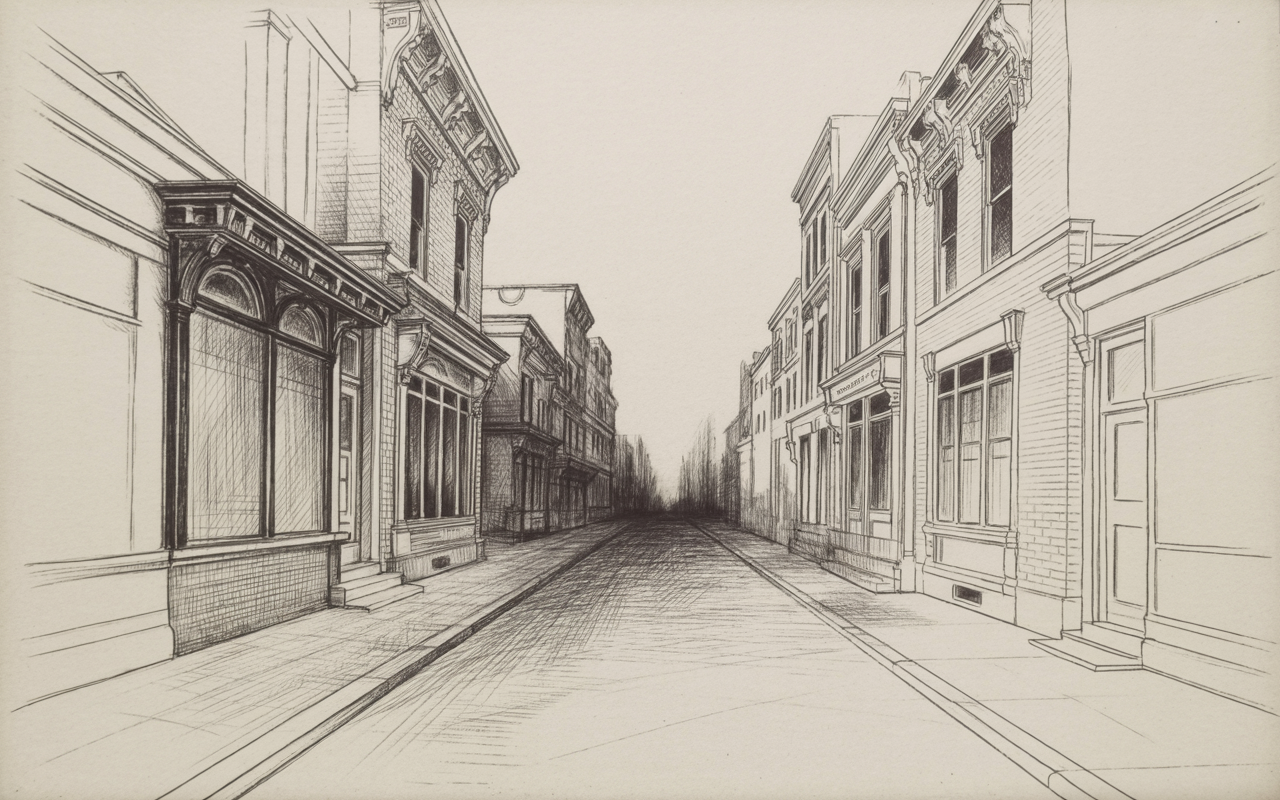
The horizon line is one of the most important tools in perspective drawing. If your horizon line is right, your room, street, or building will look solid. If it is wrong, even a well-drawn sketch can feel off.
In this article, you will learn what the horizon line is, how to place it, and how to use it in 1-point, 2-point, and 3-point perspective.
What is the horizon line in drawing?
The horizon line is your eye level. It is not always the place where the sky meets the ground. Instead, it is the height of your eyes in the scene.
A simple way to remember it:
- Wherever your eyes are, that is where the horizon line sits
- If you stand up, the horizon line moves up
- If you sit down, the horizon line moves down
Even indoors, where you cannot see a real horizon, the horizon line still exists. It is a planning line that keeps your perspective consistent.
Imagine a wardrobe, or look at it. If you look between two shelves, the one above your eye level is seen from under it. The one under your eye level is seen from above.
New to perspective? Read the full perspective drawing guide here.
Why the horizon line matters
The horizon line controls how you see objects:
- If the horizon line is high, you are looking down on things
- If the horizon line is low, you are looking up at things
- If the horizon line is in the middle, you are looking straight ahead
This affects what surfaces you can see:
- Looking down, you see more top surfaces
- Looking up, you see more undersides
- Looking straight, you mostly see side surfaces
This is why a table can look wrong. If you place the horizon line too low, the tabletop might disappear. If you place it too high, the table may look like it is seen from above.

If you want to read something historical, take a look at the Britannica.
The easiest way to find the horizon line
Try this quick real-life check:
- Hold your pencil straight out in front of you, at eye level
- Look at the point where your pencil lines up with the scene
- That level across the view is your horizon line
You can do the same thing from a chair or while standing. Your eye level changes, so the horizon line changes too.
For drawing, you do not need to measure anything. You just decide where the viewer’s eye level should be, then you draw the horizon line there.
Horizon line vs “the horizon in nature”
Many beginners mix up these two ideas.
- The horizon line in perspective is your eye level
- The horizon in nature is what you see far away, like the edge of the ocean or a distant field
Often they match, but not always. If you are on a city street, tall buildings block the natural horizon, but your horizon line still exists. It is still at your eye level.
What happens when the horizon line moves
If the horizon line is high
A high horizon line means you are looking down. You can show the tops of boxes, tables, and rooftops more easily.
Drawing ideas that fit:
- A table with objects on it
- A city seen from a hill
- A room drawn from a standing view
What to watch:
- It is easy to make things feel “too flat” if you do not add enough depth lines to guide the viewer.
If the horizon line is low
A low horizon line means you are looking up. You see the undersides more often, and tall objects feel bigger.
Drawing ideas that fit:
- A tall building from street level
- A lamppost
- A person seen from below
What to watch:
- Beginners often tilt vertical lines by mistake, which makes the scene feel like it is falling over. Keep your vertical lines straight unless you are doing 3 point perspective.
If the horizon line is centered
A centered horizon line feels balanced. It is a good choice for many beginner scenes.
Drawing ideas that fit:
- A hallway
- A road going straight away
- A simple room
What to watch:
- Centered can feel boring if everything sits exactly in the middle. You can keep the horizon centered, but move the vanishing point slightly left or right for a better composition.
How the horizon line works in 1-point perspective

In 1 point perspective, you have one vanishing point, and it sits on the horizon line.
Use this simple rule:
- Horizon line equals eye level
- Vanishing point sits on the horizon line
- Depth lines aim at that vanishing point
A classic example is a hallway. The horizon line shows the viewer’s eye level in the hallway. The vanishing point is straight ahead. Floor and ceiling edges aim toward that point.
Beginner tip: If your hallway looks tilted, your horizon line might not be level. Keep it straight across the page. You can also use a ruler.
How the horizon line works in 2-point perspective
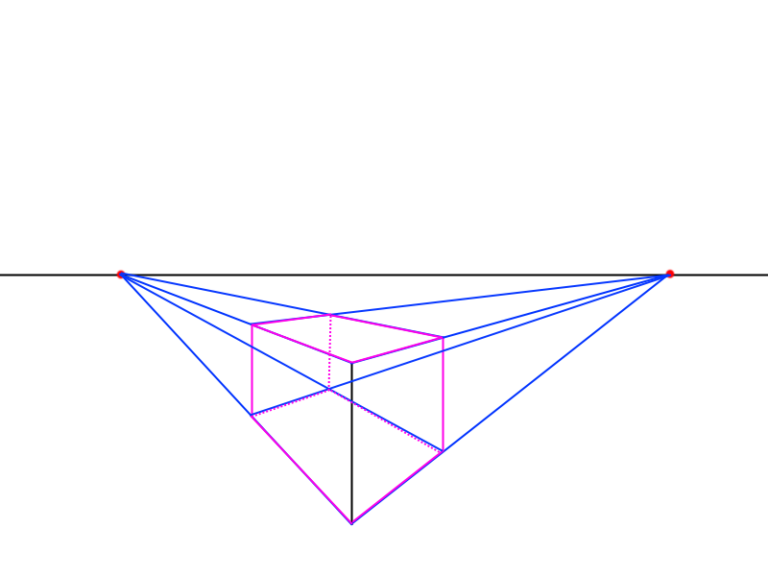
In 2-point perspective, you still have one horizon line, but you have two vanishing points. Both sit on the horizon line.
Use this simple rule:
- One horizon line for the whole scene
- Two vanishing points placed left and right on that line
- Most horizontal edges aim toward one of the two points
A common use is a corner building. Your horizon line is your eye level on the street. The building’s sides angle away toward the two vanishing points.
Beginner tip: Place the two vanishing points far apart. If they are too close, the building will look stretched and strange.
How the horizon line works in 3-point perspective
In 3 point perspective, you still have a horizon line, and it still shows eye level. The difference is that vertical lines now also angle toward a third vanishing point.
Use this simple rule:
- Two vanishing points sit on the horizon line
- A third vanishing point sits above or below the horizon line
- Vertical edges converge toward the third point
This is what makes skyscrapers look tall and dramatic when viewed from the ground. Your horizon line is low, your left and right vanishing points are far apart, and the third vanishing point is above, pulling the vertical edges inward.
Beginner tip: If your tower looks too warped, your third vanishing point might be too close. Move it farther away.
Want the full step-by-step breakdown for 1 point, 2 point, and 3 point perspective? See the complete guide.
A quick horizon line test you can do in every drawing
This is a fast check that catches many mistakes:
- Pick one object in your drawing, like a box
- Find where the top face disappears, that tells you if you are above the object
- Find where the bottom face disappears, that tells you if you are below the object
- Make sure all objects in the same scene agree on the same eye level
If one box shows a top face like you are looking down, but another box shows an underside like you are looking up, then your eye level changed. That is when drawings start to feel confusing.
Common horizon line mistakes and how to fix them
Mistake 1: The horizon line is not level
If the horizon line tilts, the whole scene can feel like it is sliding.
Fix: Use the edge of your paper or a ruler to keep it straight.
Mistake 2: Changing the horizon line mid drawing
This happens when you draw one object at one eye level, then another object at a different eye level.
Fix: Lightly draw the horizon line first and keep it visible while you build the scene.
Mistake 3: Placing the horizon line based on the sky
In many scenes, you cannot see the real horizon. If you guess, you might place eye level in the wrong spot.
Fix: Decide the viewer’s position first. Are they sitting, standing, or above the scene? Then, place the horizon line based on that decision.
Mistake 4: Using different horizon lines for connected buildings
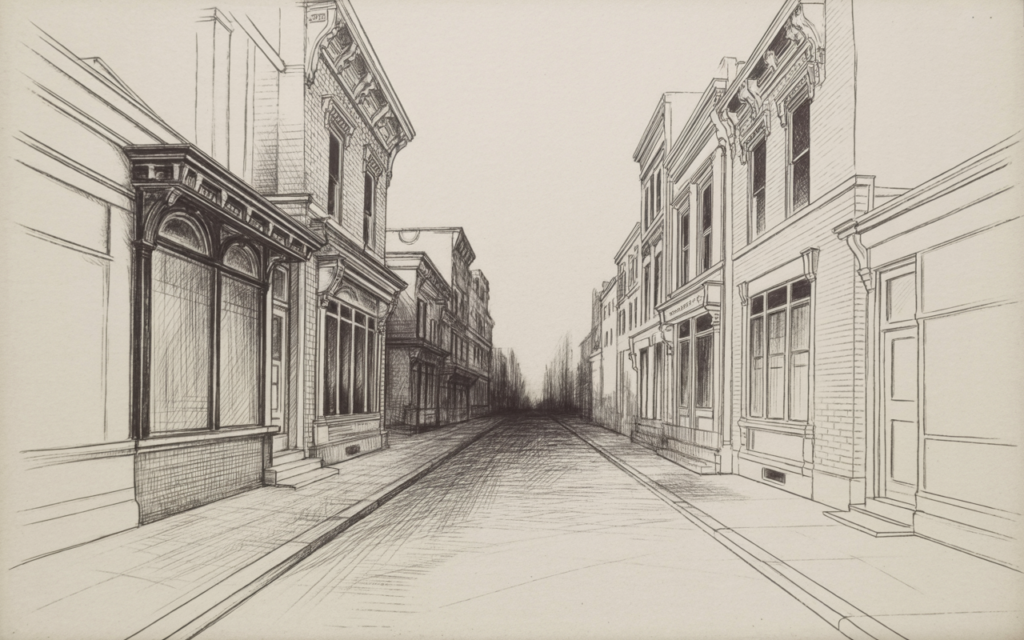
A street scene looks wrong when buildings do not share the same eye level.
Fix: Keep one horizon line for the whole street, even if buildings are different sizes.
Simple practice exercises for beginners

Exercise 1: Three horizon lines
Draw three horizontal lines across a page:
- One high
- One in the middle
- One low
On each line, draw a simple box. Keep the front face the same size. Watch how the top or bottom faces change depending on eye level.
What to focus on:
- High horizon, you see more top
- Low horizon, you see more bottom
- Middle horizon, the box feels neutral
Exercise 2: A row of boxes at the same eye level
Draw one horizon line, then place a vanishing point. Draw 5 to 10 boxes using the same point.
What to focus on:
- Consistent depth lines
- Far edges smaller than near edges
Exercise 3: A simple street corner
Draw one horizon line, then place two vanishing points. Draw one corner building, then add simple windows.
What to focus on:
- Windows follow the same vanishing points
- Vertical lines stay vertical
If you remember only one thing, remember this:
The horizon line is your eye level; it is the anchor for your whole drawing.

Once you can place eye level on purpose, perspective becomes much easier. Your boxes will feel solid, your rooms will feel real, and your street scenes will start to make sense.
What is the horizon line in drawing?
The horizon line is your eye level in the scene. It is a guide line that helps you place vanishing points and keep objects consistent in perspective, even if you cannot see a real horizon.
Does the horizon line always sit where the sky meets the ground?
No. That line in nature is the “real” horizon, but in drawing the horizon line means eye level. In indoor scenes or city streets, you may not see the real horizon at all, but you still use an eye level horizon line for correct perspective.
How do I know if my horizon line is too high or too low?
Look at your boxes and furniture. If you see a lot of top surfaces, your horizon line is high, meaning you are looking down. If you see undersides, your horizon line is low, meaning you are looking up. If it feels confusing, choose one eye level and redraw the horizon line, then rebuild the scene using that single guide.
Want more beginner-friendly drawing guides you can save for later? Check out my Pinterest for inspiration, perspective practice pages, and sketchbook ideas. Save this article to your drawing board so you can come back the next time you practice.

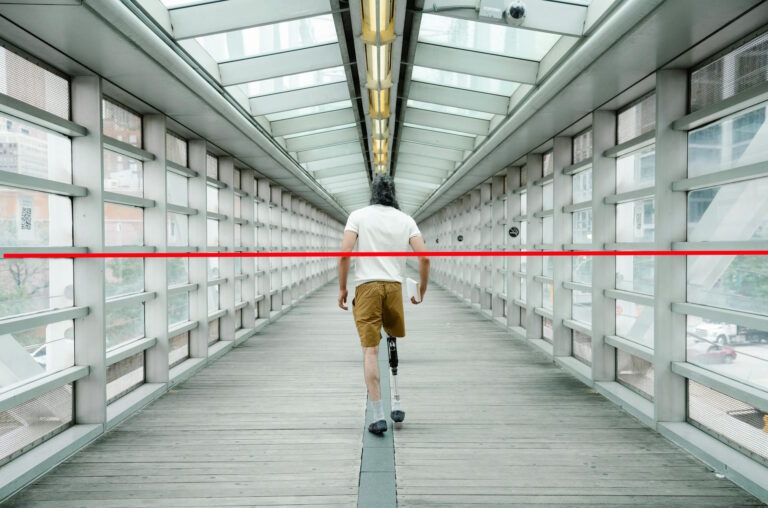


[…] An Article with a more detailed explanation of Horizon Line can be found right here! […]
[…] For more details about the Horizon Line, right this way. […]