
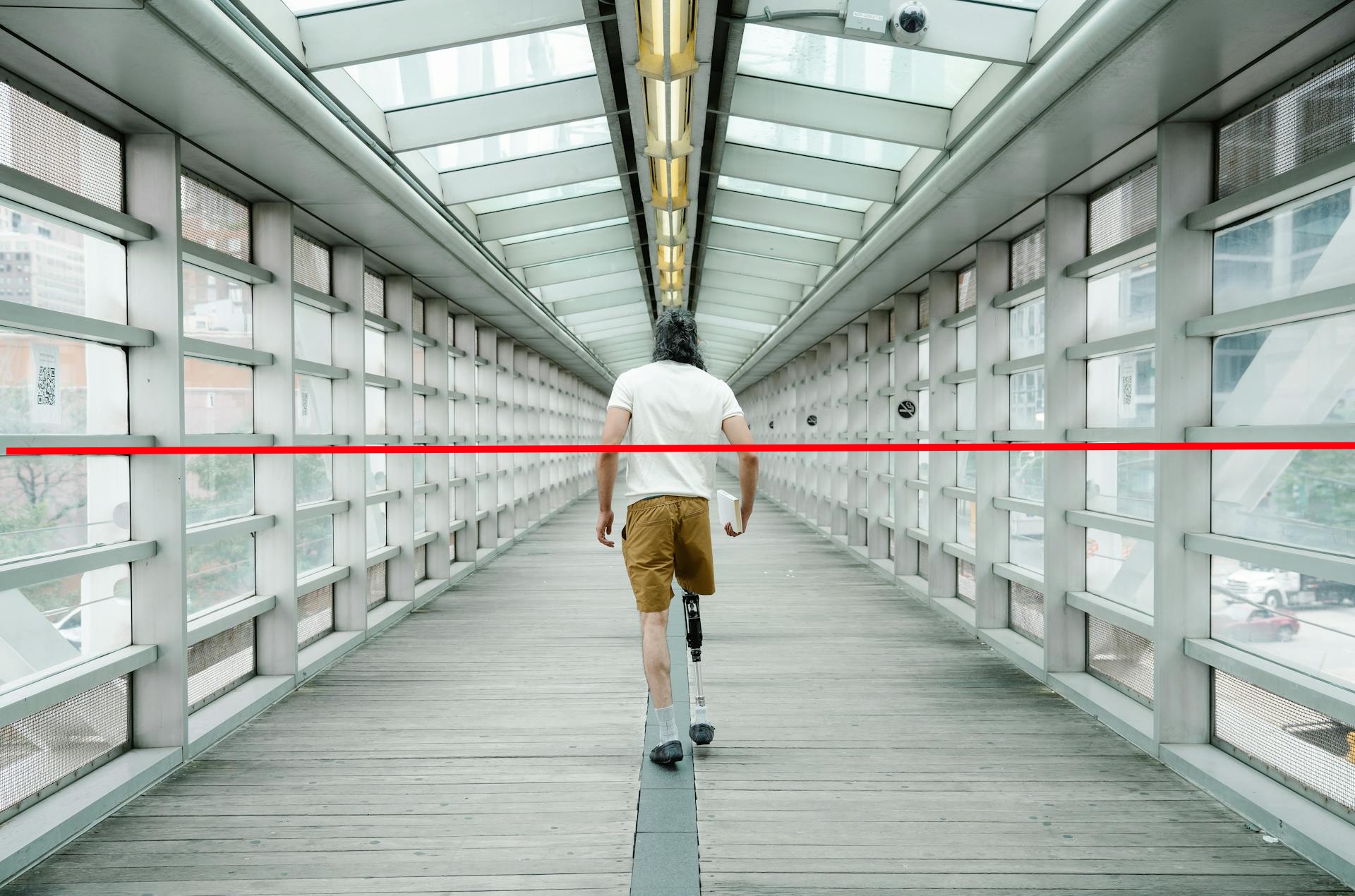
Perspective drawing is a simple way to make flat paper look like real space. It helps you draw rooms, streets, buildings, and even simple objects so they look solid and believable.
This guide explains the core ideas and then demonstrates how 1-point perspective, 2-point perspective, and 3-point perspective work. It also includes easy practice drills and common mistakes, allowing beginners to improve quickly.
What is perspective in drawing?
Perspective is a set of rules that show how things look smaller when they are farther away. It is what makes a road feel like it goes into the distance, and it is what makes a box look like it has depth.
A quick way to picture it is this:
- Things close to you look big
- Things far away look small
- Parallel lines can look like they meet in the distance
That “meeting point” is the key to perspective.
The three parts you must know for you perspective drawing
1) The horizon line
The horizon line is your eye level. It shows where your eyes are in the scene.
- If the horizon line is high, you are looking down on things
- If the horizon line is low, you are looking up at things
- If the horizon line is in the middle, you are looking straight ahead
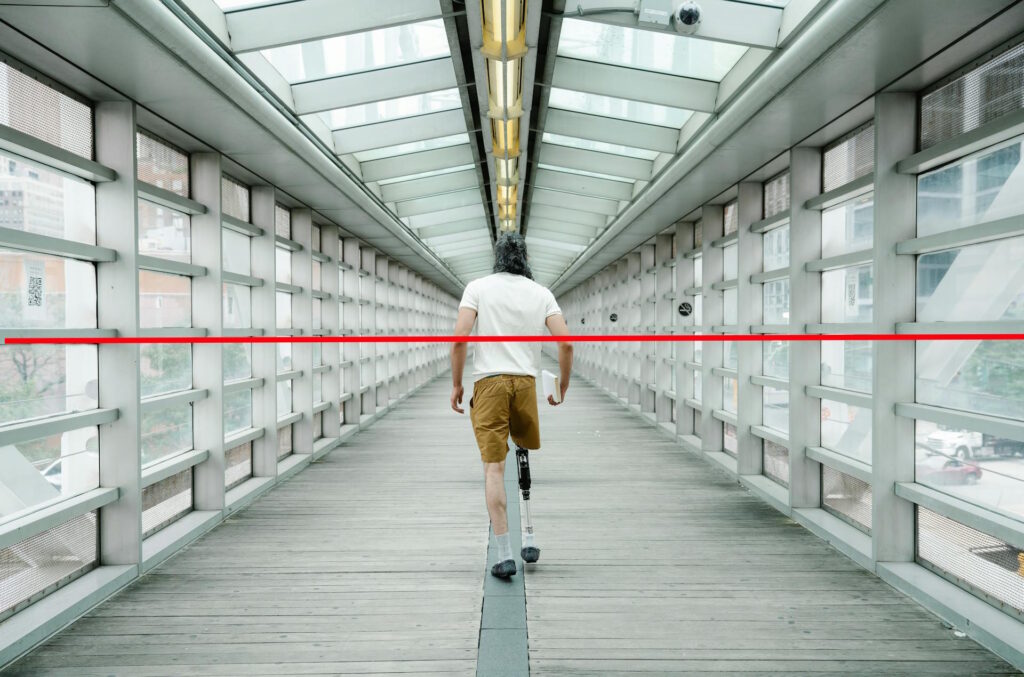
Beginner tip: Draw the horizon line lightly across the page first. Many perspective problems start because the horizon line is missing or keeps changing.
An Article with a more detailed explanation of Horizon Line can be found right here!
2) The vanishing point
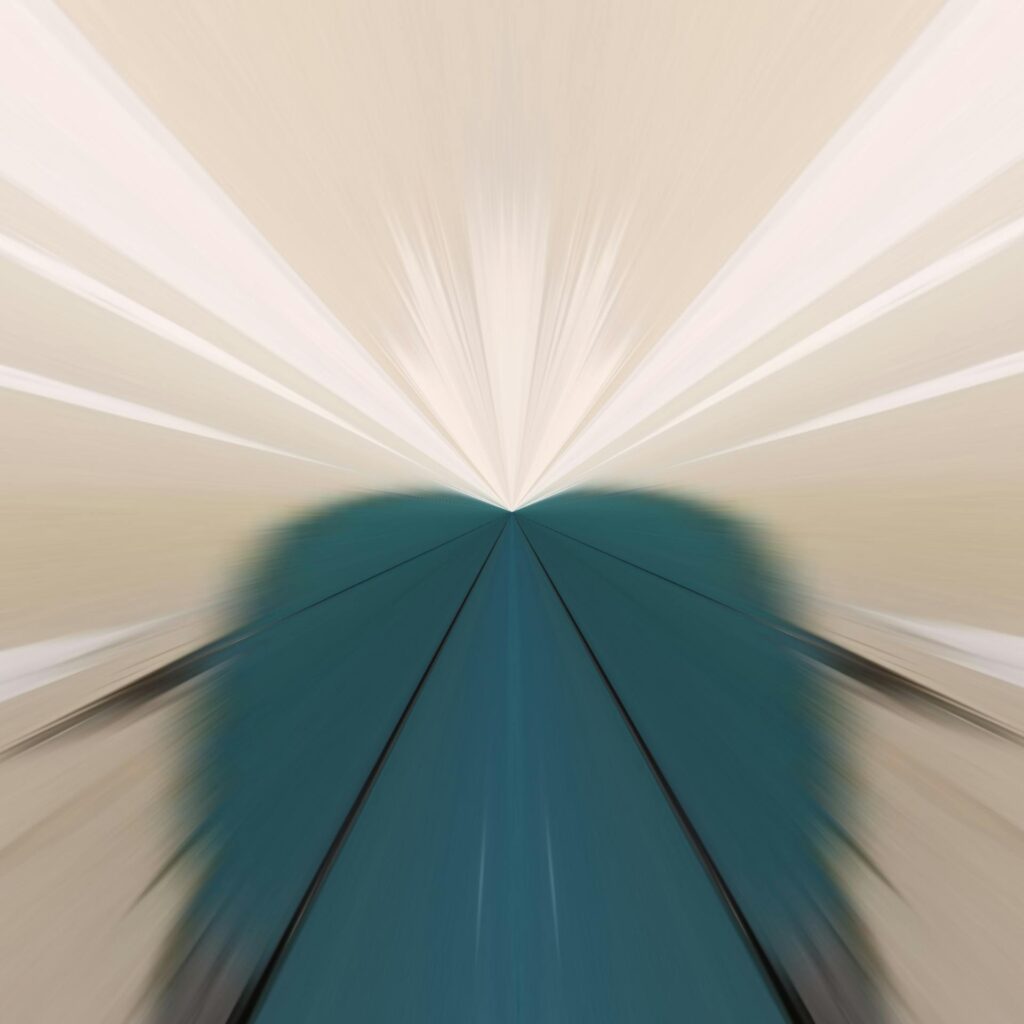
A vanishing point is a point on the horizon line where lines appear to head toward the distance.
In perspective, many edges of objects are drawn so they aim toward a vanishing point. These guiding edges help your drawing feel consistent.
A detailed article about Vanishing Points can be found right here.
3) Orthogonal lines, the “depth lines”
Orthogonal lines are the lines that go back into space. In many tutorials, these are the lines that angle toward a vanishing point. They are used to build depth.
Beginner tip: Keep orthogonal lines light. Think of them as construction lines, not final outlines.
Before you start, simple tools that help
You do not need fancy tools. This is enough:
- Pencil, HB or 2B
- Eraser
- Ruler, optional but helpful
- Paper that can handle light erasing
If you use charcoal or softer pencils later, it still helps to learn perspective first with a normal pencil, because clean lines make mistakes easier to spot.
1-point perspective
What is a 1-point perspective?
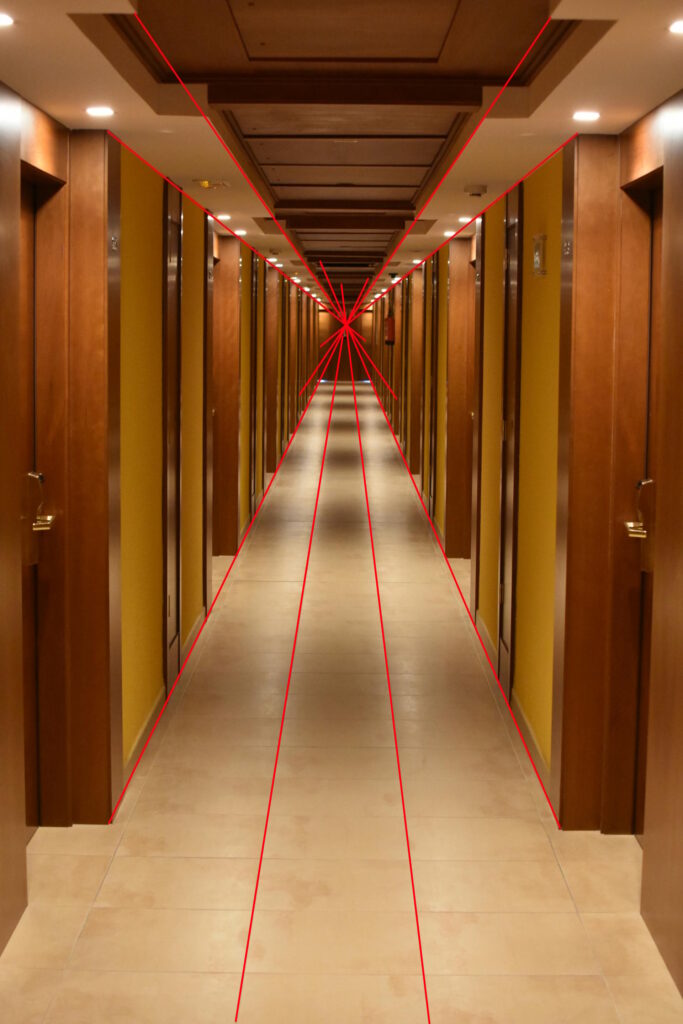
1-point perspective uses one vanishing point on the horizon line.
It works best when you look straight at a flat surface, like:
- A hallway
- A road going straight away
- A room where the back wall faces you

In 1-point perspective, the front faces of objects are usually drawn as flat shapes, like squares or rectangles, and the depth lines go to one vanishing point.
1-point perspective, step-by-step with a box
A box is the fastest way to learn perspective.
- Draw a horizon line
- Place one vanishing point on the horizon line
- Draw a square, this is the front face of the box
- From each corner of the square, draw light lines that go toward the vanishing point
- Decide how deep the box is, then draw a back edge across those lines
- Darken the final edges, erase extra construction lines
What to focus on:
- All depth edges aim to the same vanishing point
- The back face is smaller than the front face
Common beginner issue: The back face becomes larger than the front face. That breaks the depth illusion. Make the far edges smaller.
1-point perspective room, simple method
A basic room is a classic 1-point exercise.
- Draw the horizon line
- Put one vanishing point near the center
- Draw a rectangle for the back wall
- From each corner of the back wall, draw lines to the edges of the page, these become the room edges
- Add a door or window on the back wall, keep those lines straight and flat
- Add furniture using boxes built with the same vanishing point
What to focus on:
- Keep vertical lines vertical
- Keep horizontal lines horizontal on the back wall
- Only the depth lines angle to the vanishing point
Coming Soon: 1-Point Perspective Room Drawing
Common 1-point mistakes
- Moving the vanishing point mid drawing
Fix: Choose the vanishing point first and keep it. - Tilting vertical lines
Fix: Use a ruler or line up your pencil with the paper edge. - Depth lines that do not aim at the point
Fix: Lightly extend them until they clearly pass through the vanishing point.
Coming Soon: More Common 1-Point Perspective Mistakes and how to avoid them
2-point perspective
What is 2-point perspective?
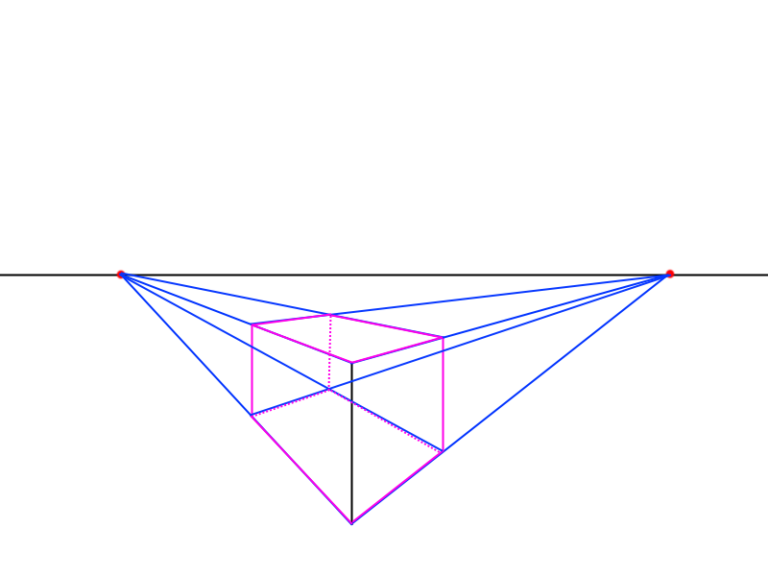
2-point perspective uses two vanishing points on the horizon line.
It is used when you look at an object from a corner view, like:
- A building on a street corner
- A box turned slightly
- A house viewed from one corner

In 2-point perspective:
- Vertical lines stay vertical
- Most horizontal edges go to one of the two vanishing points
2-point perspective, step-by-step with a box
- Draw the horizon line
- Place two vanishing points far apart, one left and one right
- Draw a vertical line in the middle, this is the closest corner of your box
- From the top and bottom of that vertical line, draw light lines to both vanishing points
- Choose the width on each side, then draw vertical lines down from those points
- Close the top and bottom by drawing edges back to the opposite vanishing points
- Darken the final edges, erase extra construction lines
What to focus on:
- The two sides of the box shrink as they go away
- The vanishing points should be far apart, close points cause heavy distortion
Beginner tip: If your page is small, put vanishing points near the edges, or even imagine them off the page.
Coming soon: More of 2-Point Perspective Boxes and Buildings. Or you can take a look at 30 Building Drawing Ideas for inspiration.
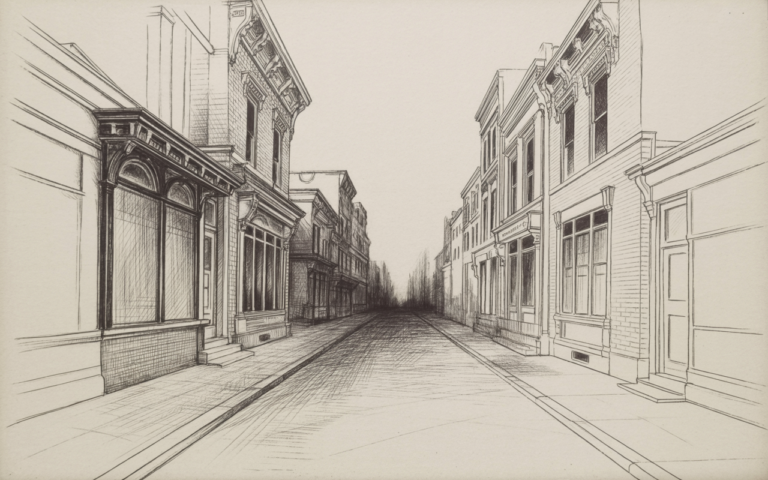
How 2-point helps with buildings
Buildings are mostly boxes. Once the main box is correct, details become much easier:
- Windows follow the same perspective lines
- Roof edges aim toward the same vanishing points
- Sidewalk lines and street edges also follow the perspective
Coming Soon: How to Draw a House in 2-Point Perspective
Coming Soon: 2-Point Perspective Streetscape
Common 2-point mistakes
- Vanishing points are too close
This makes the building look stretched.
Fix: Move points farther apart. - Vertical lines lean
Fix: Keep verticals straight, use a ruler if needed. - Mixing different horizon lines
Fix: One scene should have one horizon line, unless you are doing a special effect.
3-point perspective
What is 3-point perspective?
3-point perspective uses three vanishing points:
- Two points on the horizon line, left and right
- One more point above or below, this controls the vertical direction

3-point perspective is used when you look up at tall things, or look down from high above, like:
- Skyscrapers viewed from the street
- A city seen from a drone view
- A tall tower seen from below
3-point perspective, step-by-step idea
- Draw a horizon line
- Place left and right vanishing points far apart
- Place a third vanishing point above the horizon for looking up, or below for looking down
- Start with a tall vertical edge, but in 3-point it will angle toward the third vanishing point
- Build the form like a box, all side edges go to left and right points, all vertical edges go to the third point
- Add windows and details using the same rules
What to focus on:
- Vertical edges are not parallel anymore, they converge
- Keep the third vanishing point far enough to avoid extreme bending
Internal link placeholder: 3-Point Perspective Explained
Internal link placeholder: Draw a Skyscraper in 3-Point Perspective
Bird’s-eye view vs worm’s-eye view
- Bird’s-eye view means you look down, the third vanishing point is below the horizon
- Worm’s-eye view means you look up, the third vanishing point is above the horizon
A fast check:
- If you see the tops of things, it is often a bird’s-eye view
- If you see undersides, it is often a worm’s-eye view
Coming soon: Bird’s-Eye vs Worm’s-Eye View
Perspective practice plan for beginners to work on perspective drawing
Practice works best when it is short and steady. These drills help train your eye and your hand.
Drill 1, the box page
Fill one page with boxes:
- Row 1: 1-point boxes
- Row 2: 2-point boxes
- Row 3: Mix 1-point and 2-point, then compare
Focus on:
- Straight edges
- Consistent vanishing points
- Clean corners
Drill 2, the hallway
Draw a simple hallway in 1-point perspective:
- Floor lines to the vanishing point
- Ceiling lines to the same point
- Door frames stay vertical and horizontal on the front faces
Focus on:
- One vanishing point only
- Repeating shapes that get smaller
Drill 3, the street corner
Draw a corner building in 2-point perspective:
- One vertical corner line
- Two sides receding to left and right points
Focus on:
- Vanishing points far apart
- Windows aligned to the same perspective
Drill 4, the tall tower
Draw a tall tower in 3-point perspective:
- One strong silhouette
- Vertical lines aiming to the third point
Focus on:
- Controlling distortion
- Keeping the building readable
Coming soon: Perspective Exercises, with10 Quick Daily Drills
Why perspective often looks wrong
If a drawing feels off, the cause is usually simple. Use this checklist.
Quick fix checklist
- Is there a clear horizon line?
- Are vanishing points placed and kept consistent?
- Do depth lines actually aim at the correct point?
- Are vertical lines straight, unless it is 3-point?
- Are repeated objects getting smaller in a steady way?
Coming Soon: Checklist Why Your Perspective Looks Wrong
Shading tips that support perspective
Perspective is not only about lines. Shading can make depth feel stronger.
Simple rules that help:
- Add darker values on the side facing away from the light
- Keep the far objects a bit lighter, softer edges help depth
- Use cast shadows to “anchor” objects to the ground
Beginner tip: Even one simple shadow under a box makes it look more real.
FAQ
What is the easiest type of perspective to learn?
1-point perspective is usually easiest because it uses one vanishing point and simple depth lines.
Do vanishing points have to be on the paper?
No. In 2-point and 3-point perspective, vanishing points are often far away. It is normal to place them off the page and imagine the lines aiming toward them.
Why do my boxes look twisted?
Most of the time, the depth lines do not aim at the same vanishing point, or the horizon line changes during the drawing.
Can perspective be drawn without a ruler?
Yes. A ruler helps at first, but freehand perspective is possible. The key is light construction lines, then clean final lines.
Next steps
To build skill fast, start with one page of 1-point boxes, then one simple room, then move to 2-point boxes and a corner building. After that, the 3-point perspective becomes much easier.
Want more easy perspective drawing ideas you can save and practice later? Visit my Pinterest and follow along. I post drawing ideas, sketchbook prompts, and simple drawing exercises you can pin for your next art session. Save this guide to your “Drawing Tips” board so you can come back anytime.



[…] New to perspective? Read the full perspective drawing guide here. […]
[…] If you want to learn more about perspective, you can read Perspective Drawing: A Complete Beginner Guide to 1-Point, 2-Point, and 3-Point Perspective. […]
[…] Perspective: Perspective gives your drawings a sense of space and distance. Once you understand how objects appear smaller as they move further away, your scenes start to feel real. One-point and two-point perspective are great starting points, and even a basic understanding of these can completely change how you approach a drawing. If you don’t know what I’m talking about, take a look at My Complete Beginner Guide to 1-Point, 2-Point, and 3-Point Perspective. […]
[…] Here you can read more about perspectives. […]
[…] Perspective was another skill I tackled. You can read more about it here. […]