
If your drawings look a little “off” but you can’t figure out why, vanishing points might be the missing piece. Once you understand how they work, your sketches will start to look more real and three-dimensional. The good news: this is not complicated math. It is just learning to see the way your eyes already work.
What Is a Vanishing Point?
A vanishing point is a spot on your drawing where parallel lines appear to meet. In real life, parallel lines never actually touch. But when you look down a long road or a hallway, they seem to come together in the distance. That point where they “disappear” is the vanishing point.
Think about standing on train tracks. The rails are the same distance apart the whole way. But looking ahead, they seem to get closer and closer until they meet at one spot on the horizon. That spot is the vanishing point.

In drawing, you use this trick on purpose to make flat paper look like it has depth.
The Horizon Line: Where It All Starts
Before you can place a vanishing point, you need a horizon line. This is a horizontal line across your drawing that represents eye level.
Here is the key thing to understand: the horizon line is always at the viewer’s eye level. If you draw it high on the page, the viewer is looking down at the scene. If you draw it low, the viewer is looking up. If it is in the middle, you are looking straight ahead.
For more details about the Horizon Line, right this way.
Every vanishing point sits on this line (in most basic perspective setups).
One-Point Perspective
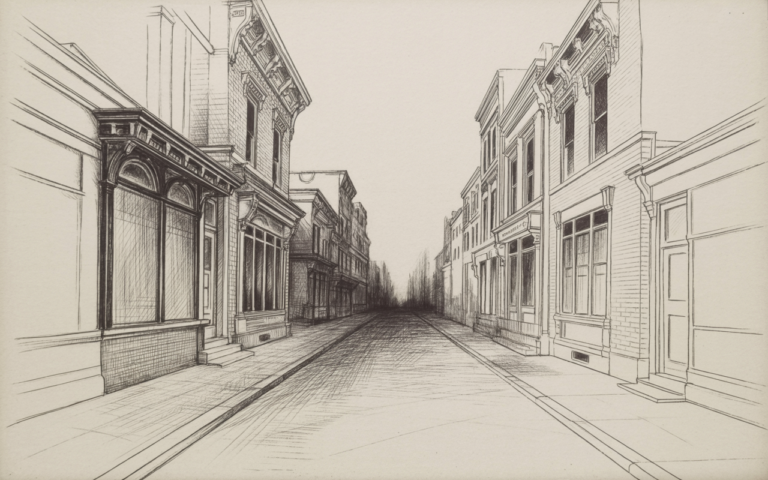
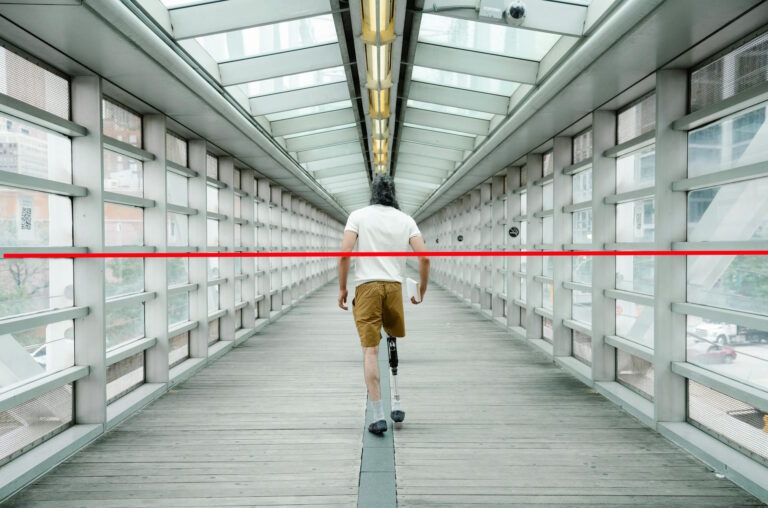
One-point perspective uses a single vanishing point. It works great for scenes where you are looking straight at something, like a hallway, a road going away from you, or a box sitting right in front of you.
How it works:
You place one dot on your horizon line. That is your vanishing point. Then you draw lines from the edges of your object toward that dot. The lines get closer together as they go back, which makes the object look like it is going into the distance.
Good for:
- Interiors (looking down a room)
- Straight roads or paths
- Front-facing buildings
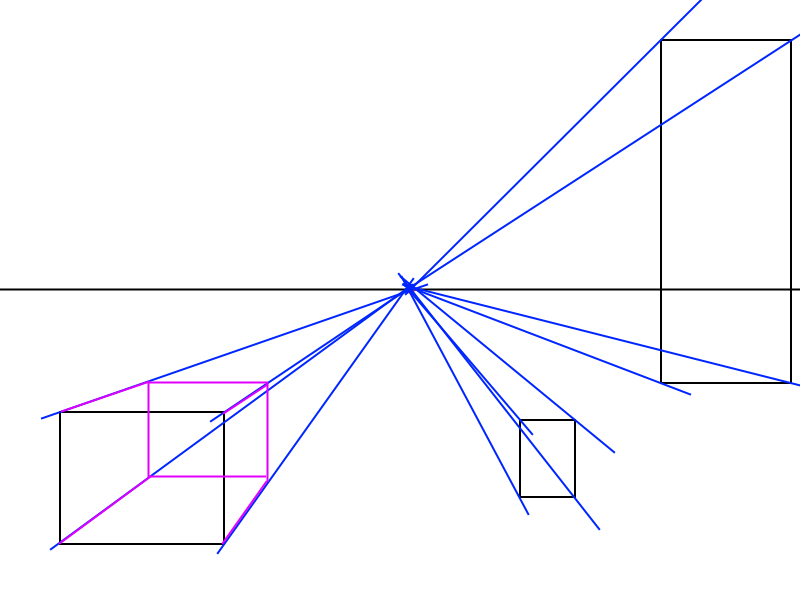
One-point perspective is the easiest to start with. It gives you a solid feel for how depth works before adding more complexity.
Two-Point Perspective
Two-point perspective uses two vanishing points, one on the left and one on the right of the horizon line. You use this when you are looking at the corner of an object, like the corner of a building or a box turned at an angle.
How it works:
Instead of seeing one flat face head-on, you see two sides. Each side has its own vanishing point. The vertical edges of the object stay straight up and down. But the top and bottom edges of each face angle toward their own vanishing point.
Good for:
- Buildings viewed from a corner
- Furniture at an angle
- Street scenes and cityscapes
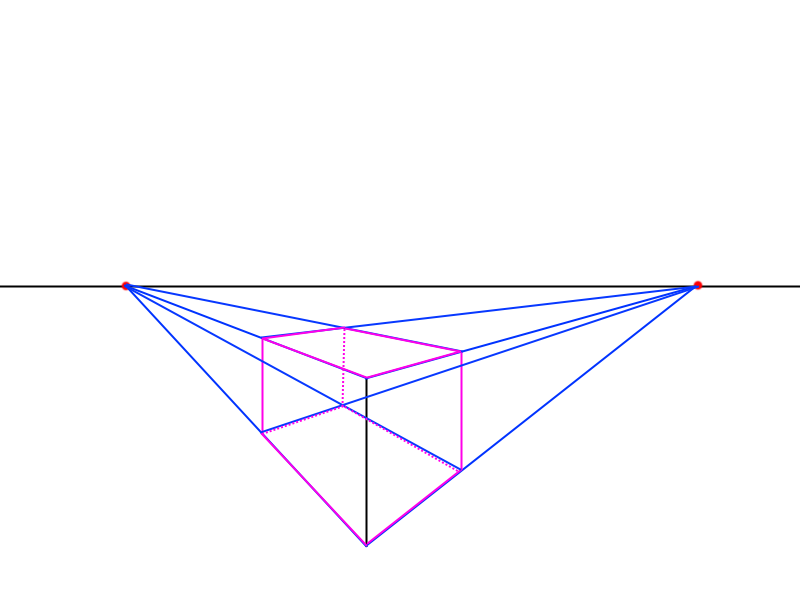
Two-point perspective is the most common type you will use for everyday sketching. It feels natural because it matches how we actually see most objects.
For ideas on drawing buildings, you can take a look here.
Three-Point Perspective
Three-point perspective adds a third vanishing point, either above or below the horizon line. You use this when looking steeply up at something tall or looking down from a high place.
How it works:
The first two vanishing points work like in two-point perspective. The third point is placed high above (for a worm’s eye view) or low below (for a bird’s eye view). Vertical lines now angle toward this third point instead of staying perfectly straight.
Good for:
- Tall skyscrapers viewed from below
- Looking down from a cliff or rooftop
- Dramatic action scenes
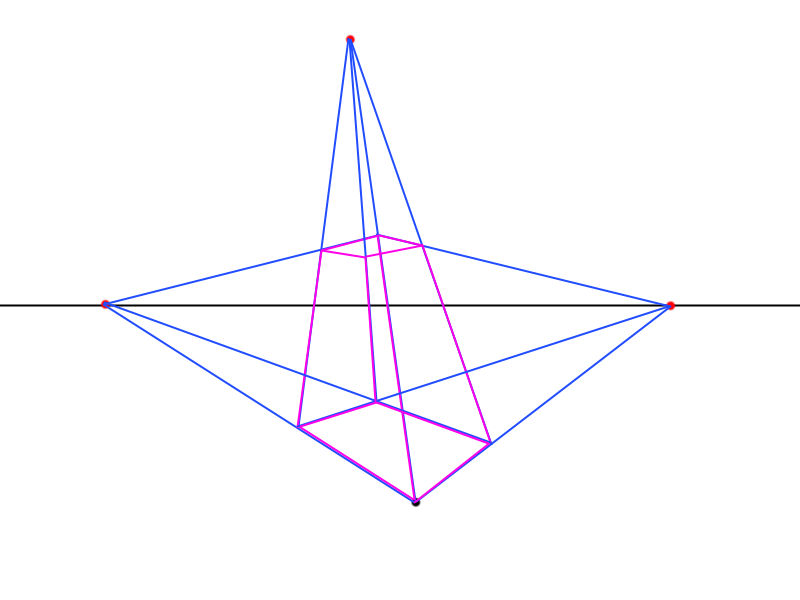
Three-point perspective adds a lot of energy and drama. It is great once you are comfortable with one- and two-point.
Where to Place Your Vanishing Points
This is where a lot of beginners go wrong. They place their vanishing points too close to the center of the drawing. This makes objects look squished and distorted.
A good rule: push your vanishing points toward the edges of your paper, or even off the paper entirely. The farther apart they are, the more natural your drawing will look.
When vanishing points are too close together, the perspective looks extreme, like a fisheye lens. That can be a cool effect on purpose, but for realistic scenes, give those points space.
A Simple Exercise to Try
Here is a quick practice you can do right now:
- Draw a horizontal line across the middle of your paper. That is your horizon line.
- Put a dot near the center of that line. That is your vanishing point.
- Draw a small rectangle near the bottom of the page (this is the front face of a box).
- Draw lines from each corner of the rectangle up to the vanishing point.
- Draw another horizontal line between the vanishing lines to close off the top and side of the box.
You just drew a box in one-point perspective. Simple as that.
Common Mistakes (And How to Fix Them)
Mistake: Ignoring the horizon line. If your vanishing points are not on the same horizon line, your drawing will look wrong. Always start with the horizon line first.
Mistake: Placing vanishing points too close together. This makes your perspective look stretched and unnatural. Move them further apart.
Mistake: Making all lines go to the vanishing point, including ones that should not. Vertical lines (in one- and two-point perspective) do not go to a vanishing point. They stay vertical. Only horizontal edges and depth lines converge.
Mistake: Getting too rigid. Perspective is a guide, not a rule you have to follow perfectly every time. Many artists use it as a rough framework and then draw freehand on top of it. Use it to check your work, not to chain yourself to a ruler.
Why This Matters for Your Drawings
Understanding vanishing points gives you control. Instead of guessing why something looks off, you have a system to check your work. It also trains your eye over time. After practicing with perspective grids, you start to see these lines in the real world and can sketch more accurately without even drawing the lines.
If you draw buildings, interiors, vehicles, or even just want your still life objects to feel grounded in space, vanishing points will make a real difference.
If you want to learn more about perspective, you can read Perspective Drawing: A Complete Beginner Guide to 1-Point, 2-Point, and 3-Point Perspective.
Quick Reference: Which Perspective to Use
| Situation | Perspective Type |
|---|---|
| Looking straight down a road or hallway | One-point |
| Viewing the corner of a building | Two-point |
| Looking up at a tall tower | Three-point |
| Bird’s eye view from above | Three-point |
| Simple box or room interior | One-point or two-point |
What to Practice Next
Start with one-point perspective and draw a simple room interior or a long hallway. Once that feels comfortable, move to two-point and try drawing a building corner. Give yourself time with each stage before jumping ahead.
Perspective is one of those skills that clicks after you have drawn it a few times. You do not have to master it before moving on, but knowing the basics will make every drawing you do feel more solid and convincing.


[…] A detailed article about Vanishing Points can be found right here. […]